
(Analysis for informational purposes only. Capital at risk.)
Summary
- The Strategic Signal: Uber & Lyft’s 2026 Robotaxi partnership with Baidu in London underscores the competitiveness of Chinese low-cost autonomous driving solutions in the international market.
- The Valuation Dislocation: At current levels, Baidu trades at a structural dislocation. Our Sum-of-the-Parts (SOTP) analysis implies the Apollo Robotaxi unit is effectively priced at ~7 cents on the dollar relative to Waymo’s private market benchmark.
- The “Show me the money” Test: Ultimately, the sector is pivoting from “promise” to “profit.” Robotaxi platforms must pass the “show me the money” test by demonstrating sustainable unit economics to justify and sustain their valuations.
Uber, Lyft and Baidu signal a step‑change for UK robotaxi development
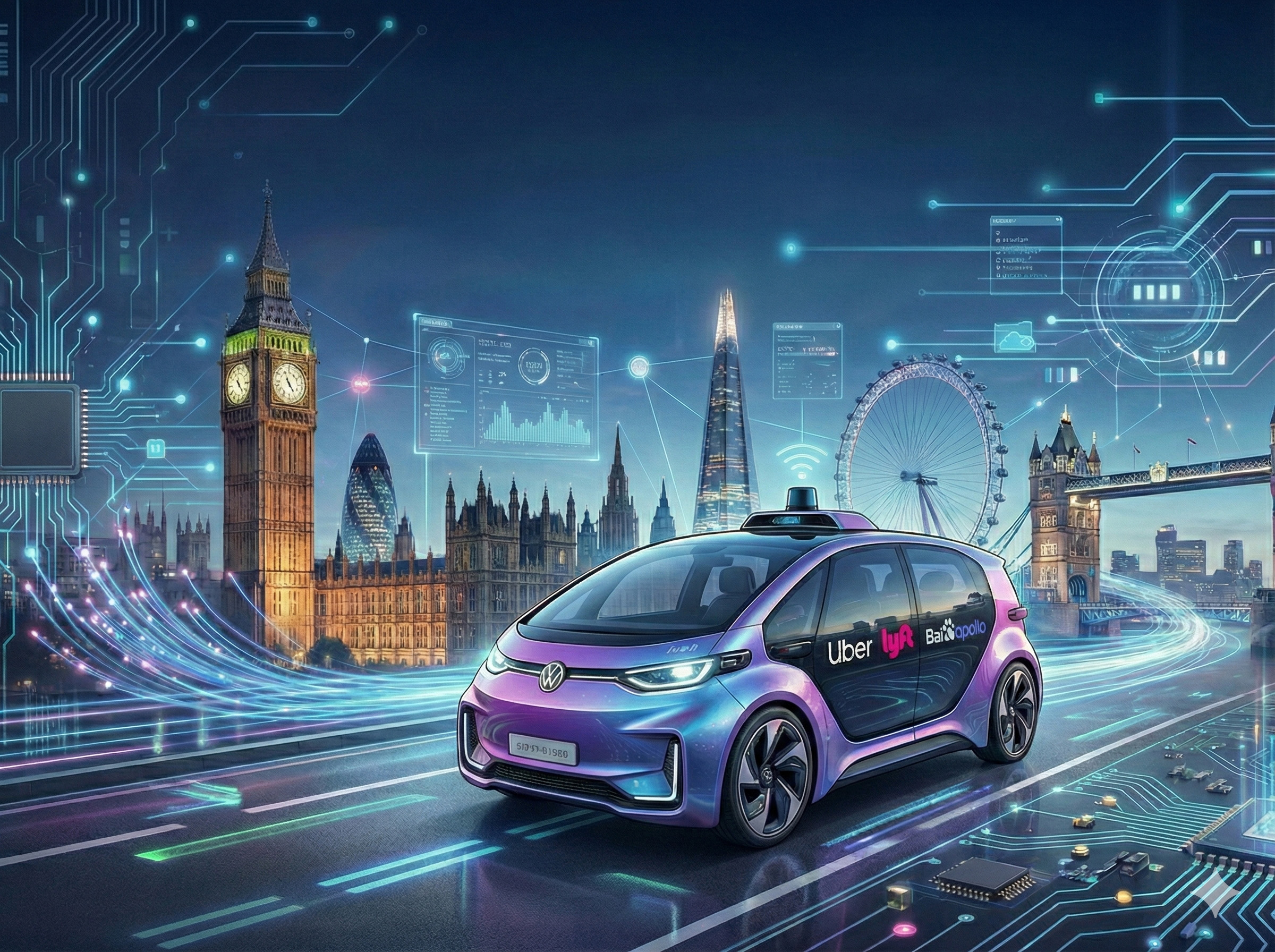
Uber and Lyft’s decision to partner with Chinese tech giant Baidu to test robotaxis in London in 2026 marks a major milestone for autonomous driving in the UK and an acceleration of Chinese autonomous driving expansion into Europe. The move follows Waymo’s recent entry into the UK market and suggests a wave of new entrants from 2026 onwards.
After earlier attempts to build in‑house autonomous driving systems, Uber and Lyft are now prioritising their core competency—network operations—while outsourcing vehicle autonomy to technology partners. Choosing Baidu rather than a U.S. supplier is notable given ongoing U.S.–China geopolitical tensions in technology and underscores the competitiveness of Chinese autonomous driving technology in the international market.
The ‘Regulatory Firewall”
While the partnership appears to be a technological and operational choice, it also serves as a risk-transfer mechanism that protects Uber’s and Lyft’s balance sheet under the UK’s Automated Vehicles Act 2024.
The Act shifts criminal and civil liability from the driver to the “Authorised Self-Driving Entity” (ASDE). Securing ASDE status requires significant capital reserves for insurance and safety validation. By partnering with Baidu, Uber and Lyft are constructing a “Regulatory Firewall”:
- Baidu (The ASDE): Assumes the regulatory burden, insurance costs, and legal exposure as the manufacturer/operator.
- Uber/Lyft (The Broker): Retains the customer relationship and booking fee while keeping the “crash risk” off their balance sheet.
This structure potentially allows the ride-hailing giants to remain asset-light and liability-remote, outsourcing the cost of UK regulatory compliance to Baidu. For Baidu, absorbing this liability is the strategic “cost of entry” required to deploy its RT6 fleet in Europe’s most valuable mobility market.
Baidu’s offering: Apollo RT6 and cost advantage
Baidu will deploy its Apollo RT6 — a purpose‑built EV for ride‑hailing — in the UK tests. The RT6 is equipped with 38 sensors, including eight LiDARs, and has an estimated cost of roughly £ 21k (CNY 200k), significantly lower than Western competitors like Waymo, which carries an estimated cost of over £80K.

For Uber and Lyft, this effectively imports Chinese manufacturing deflation into the UK. Baidu has already achieved unit-economics breakeven in Wuhan. By utilizing an low-cost fleet, operators can achieve fleet profitability significantly faster than competitors burdened by high hardware cost.
Why the UK matters for L4?
The Automated Vehicles Act 2024 strengthens the UK’s position by shifting legal liability for Level‑4 (L4) autonomous operation from the user to the manufacturer once safety cases are approve1d, and by allowing scaling once regulators are satisfied. This single‑act approach also provides a more centralised, predictable framework than the more fragmented regulatory regimes in some EU countries, such as France and Germany.
UK’s Autonomous Driving Roadmap
The UK government has established a long-term autonomous driving strategy anchored by 2035 targets, while the broader industry generally views 2030 as the “tipping point” leading up to that goal.
- 2030: Commercial self-driving services operational across the UK’s Strategic Road Network, moving beyond isolated city pilots to inter-city logistics and mass transit.
- 2035: The UK connected and automated mobility (CAM) sector is projected to generate £42bn in economic value and create 38,000 skilled jobs, with roughly 40% of new car sales expected to feature significant self-driving capabilities.

The “Big Four” in L4 autonomous driving
We identify four leading L4 players: Waymo (Alphabet), Baidu (BIDU / 9888.HK), Pony AI (PONY US/2026 HK), and WeRide (WRD US/800 HK). Waymo remains the leader in fleet size and driverless mileage, with Baidu a close second. Pony AI and WeRide are smaller individually, but collectively Chinese players operate at a comparable scale to Waymo.
- Waymo: fleet ~2,500 vehicles, ~204m km driverless mileage, ~450k paid rides per week, ~20m km of total robotaxi rides in the U.S. Waymo’s vehicles (e.g., Jaguar, Zeekr models) are materially more expensive on a per‑vehicle basis than Baidu’s RT6.
- Baidu: About 240m km of AV testing, of which 140m km were driverless. Apollo Go reportedly operates over 1,000 robotaxis, has completed over 17m rides, and now fulfills approximately 250k fully driverless orders per week.
- Pony AI: About 1,000 robotaxis currently; target fleet of 3,000 by 2026; international expansion into Qatar, South Korea, Singapore, and Luxembourg.
- WeRide: About 750 robotaxis and >1,600 L4 vehicles, About 55m km of L4 mileage, and international licenses across US, UAE, Saudi Arabia, Singapore, and several European countries.


Tesla as a looming contender
Tesla is a credible challenger despite a later commercial robotaxi push (mid‑2025). Its advantages are a massive driving dataset (over 7bn miles of FSD usage) and market-leading FSD software. Currently, Tesla has about 1,000 robotaxis but still requires human safety drivers.
Commercialisation remains in an early stage
L4 robotaxi services are still at an early commercial stage; revenue contribution and profitability for most operators remain limited:
Waymo: Waymo’s standalone financials are not disclosed by Alphabet, but it is widely believed to be operating at substantial losses due to heavy ongoing investment in technology, fleet expansion, and operations. Reportedly, Waymo is in talks to raise over USD 15bn in a new funding round at a potential valuation of up to USD 100bn—more than double its reported USD 45bn valuation from October 2024. If completed, the deal would provide a new valuation reference for other L4 robotaxi platforms.
Baidu (BIDU US/9888 HK): By Oct 2025, Apollo Go recorded ~240m autonomous km (140m fully driverless). In 3Q25 Apollo Go delivered 3.1m fully driverless rides, up 212% YoY. Baidu has not disclosed material revenue from autonomous driving; its near‑term earnings remain dominated by online marketing (c.62% of revenue) and AI cloud/applications (c.38%).
Poni AI (PONY US/2026 HK): Operating ~1,000 robotaxis and expanding internationally. 3Q25 revenue was ~USD 25m (+74% YoY), but the company posted a USD 61m net loss in the quarter (net margin ≈ -241%), with R&D (~USD 60m) heavily outweighing current revenue.

WeRide (WRD US/800 HK): As of Oct 2025, the company reported ~750 robotaxis, >1,600 L4 vehicles, and ~55m km of L4 mileage. 3Q25 revenue rose 144% YoY to ~USD 24m, but WeRide reported a USD 43m quarterly net loss (net margin ≈ -179%), again reflecting high R&D spend (~USD 44m).

On a positive note, Chinese robotaxi operators are reaching or approaching unit‑economics breakeven in selected markets. Baidu has achieved unit‑economics breakeven in Wuhan, while Pony AI recently reached breakeven in Guangzhou following the rollout of its Gen‑7 robotaxis. WeRide expects to reach breakeven in Abu Dhabi after securing permission to remove the in‑vehicle safety officer. These milestones suggest robotaxi platforms are moving toward a “profitability inflection point” where proven unit economics in a few core cities can be replicated elsewhere.
Baiu’s Valuation Paradox: ‘Free Option’ on Autonomy?
The London pilot exposes a disconnect in global valuation multiples.
Waymo, the leading US player, has reportedly seeking valuations exceeding USD100bn in recent capital raises. On the other hand, Baidu—China’s leading player —trades at a market cap of about USD50bn. But Baidu is not a pure-play AV startup; it is a internet conglomerate with various segments.
To access the implied value of the autonomous driving unit (Apollo), we perform a SOTP analysis as below.
- Net Cash & Investments: Baidu holds ~USD 21bn in net cash and long-term investments (after holding discounts).
- Cloud Business: Valuing the AI Cloud division at a conservative 3x P/S yields ~USD 15bn.
- Search business: Even applying a distressed 5x P/E multiple to the mature advertising business contributes ~USD 7bn.
The Implied Alpha: When these components are deducted from the market cap, the implied value assigned to Apollo is approximately USD 7bn.
At current levels, investors are paying a ‘distress price’ for the search business and acquiring the Apollo option for ~7 cents on the dollar relative to Waymo.
| Asset Component | Net Value (USD bn) | Per Share (USD) | Methodology (with 25% holding discount) |
| Cash & Investments | 21 | 63 | Book Value |
| AI Cloud | 12 | 36 | 2.5x Price/Sales |
| Core Search (Ads) | 7 | 19 | 5.0x P/E (Distress multiple) |
| iQiyi | 1 | 2 | |
| Sum of Non-Robotaxi Assets | 41 | 120 | |
| Current Market Cap | 48 | 142 | |
| Implied Value of Apollo | 7 | 21 | (Market Cap – Sum of Assets) |
| Benchmark: Waymo | 100 | Private Market Valuation | |
| Discount to Waymo | 93% |
The risk-reward profile
As discussed above, the market has priced Baidu’s autonomous ambitions at low value. This creates an asymmetric risk-reward profile:
- Downside protection: Supported by the profitable search utility and a net cash position covering ~40% of the market cap.
- Upside optionality: Exposure to the only non-US autonomous fleet with global scale, entering a Tier-1 Western market with a structurally lower cost base.
Should Baidu can demonstrate positive unit economics in a high-labour-cost market in the long run, a re-rating of the Apollo asset might happen.
The Valuation regime: From ‘proxies’ to ‘profits’
While Baidu’s individual valuation appears dislocated, it suffers from a broader industry skepticism.
Valuing robotaxi platforms such as Waymo is challenging because commercialisation is still nascent and companies are investing heavily in R&D and fleet expansion. With “small revenue, big losses” profiles, conventional multiples such as P/E or P/S based on current or near‑term financials are often meaningless.
One approach is to build a long‑term financial forecast (for example, a 10‑year model), apply DCF techniques, or use EV/EBITDA or P/E on long‑dated estimates (e.g., 2030E) and discount back to today. However, these long‑horizon methods are sensitive to assumptions and less reliable when industry visibility is low and outcomes hinge on regulatory shifts, unit economics, and competitive dynamics.
Alternatively, investors can supplement traditional metrics with scale‑oriented proxies—for example, price‑per‑vehicle or price‑per‑ride—that capture fleet size and commercial activity.
Price per vehicle: This metric values the implied value for each autonomous vehicle as a revenue generating asset like a hotel room.
Price per weekly ride: This effectively values the volume of commercial activity, instead of just the asset (fleet) size. This is the “Facebook DAU (Daily Active User)” metric for Robotaxis.
For instance, PE investors recently reportedly valued Waymo at about USD100bn, based on its 450,000 paid weekly rides and 2,500 vehicles, which implies a valuation of roughly USD222,000 per weekly active ride or USD40mn per vehicle. On the other hand, the public equity market is valuing USD6.8mn per vehicle and USD2.9mn per vehicle for Pony AI and WeRide respectively, much lower than Waymo.

On the flip side, these alternative metrics are essentially “proxy” valuations, focusing on top-line activities (rides and vehicles) and ignoring crucial fundamentals such as unit economy, cost-per-miles, utilization, cash flows, etc.
In addition, the market is applying a significant premium to Waymo, reflecting a perceived moat and first‑mover advantage. Should an emerging player like Tesla successfully enter the market and achieve scale, such premium (and implied per‑vehicle valuations) could compress sharply.
The Ultimate “Show Me the Money” Test
Ultimately, robotaxi platforms must pass the “show me the money” test. Currently, many valuations are premised on promise — fleet size, miles and ride volume — but over time investors will demand proof of sustainable profitability. In that phase, robotaxi platforms must generate enough cash to cover operating costs and capex. If unit economics do not improve, the sector would faces a de-rating. The market will stop valuing these companies as high-margin software platforms (based on P/S) and start valuing them as capital-intensive fleet operators (based on P/B).
This article is a “periodical publication” for information only and is not investment advice or a solicitation to buy or sell securities. This article does not constitute a “Personal Recommendation” or investment advice under UK FCA regulations. Investing in Asian markets involves significant risk. The author holds NO position in the securities mentioned. There is no warranty as to completeness or correctness. Please do your own due diligence or consult a licensed financial adviser. Please read the Full Disclaimer before acting on any information. Images created with the assistance of Gemini AI.
Latest posts
Leave a Reply